
Oneshot Fishing is listed in CQ9’s public game catalogue. PAGCOR’s CQ9 electronic-game list identifies ONESHOT FISHING as an arcade-type product with identifier AT01. This establishes a more useful identity than the name alone, but does not establish the rules, availability or authorisation of any ABC8 implementation.
The title does not promise a one-shot outcome
A product name is not a probability statement. “Oneshot” should not be read as a guarantee that one action captures a target, completes a feature or returns a prize. Such a claim would require a specific rule describing the event and its conditions.
The public catalogue and the regulator’s version entry answer who and what the product is. They do not disclose a complete per-target probability table. That distinction matters when a video caption presents a dramatic event as an outcome that anyone can reproduce.
What the public feature descriptions say
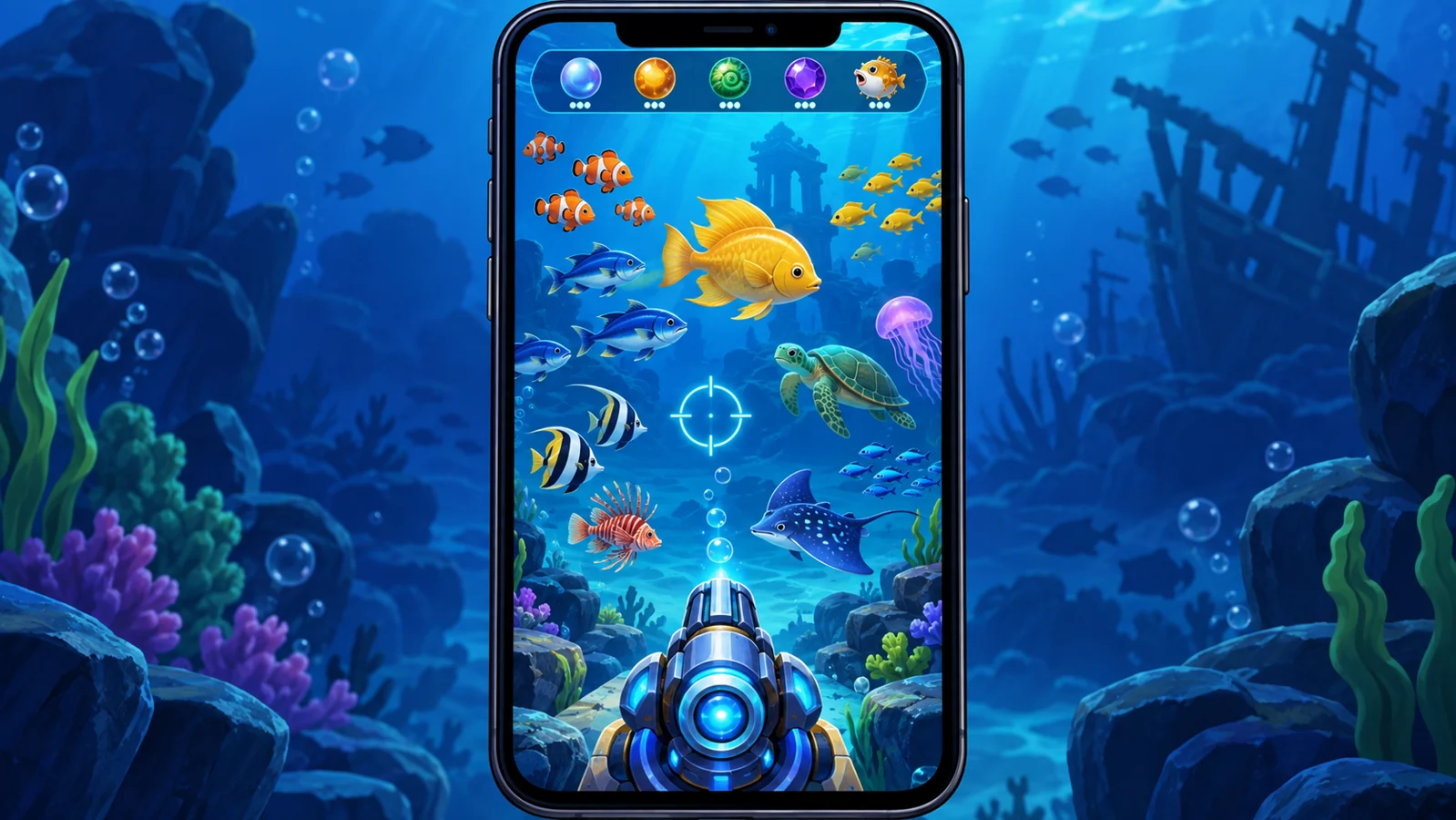
A public operator listing describes a portrait-oriented fishing game, a shared room and a collection feature involving seven dragon balls and a dragon boss. These are secondary descriptions of a listed version, not independently verified ABC8 settings. Published third-party return and maximum-award figures are not sufficiently consistent to present as settled specifications here.
The useful conceptual distinction is between ordinary arcade activity and a collection-triggered event. A collection counter describes a recorded state. A trigger is the condition that starts an event. An award is the result credited under that event’s rules. These should not be treated as interchangeable.
Progress is not the same as recoverable value
Consider a fictional collection display with six of seven markers filled. That display does not tell you how likely the seventh marker is, how much another attempt costs, whether the state persists after leaving or what any completed event would return.
Those missing facts prevent a calculation of the cost of completion. Even if the first six markers took a particular number of attempts, simply dividing that history to predict the seventh would assume a mechanism that has not been established.
This is an explanation of incomplete information, not a claim about Oneshot Fishing’s underlying algorithm. It also illustrates why “I have already spent this much” is not evidence that further spending will recover it.
Read a collection feature as a state, not a promise
A collection counter can be described as a set of states: no markers, some markers, a completed collection and a subsequent event. The transitions between states are the missing part of many promotional explanations. Knowing that a display has seven positions does not explain how the positions are filled.
| Question about a collection | Why it matters |
|---|---|
| What records a marker? | An animation alone may not establish that the collection state changed. |
| Is the state personal or shared? | A room display may differ from an individual account’s record. |
| Does it persist after leaving or changing devices? | Persistence cannot be inferred from a screenshot of an unfinished state. |
| What happens when it completes? | Starting an event is different from receiving a defined award. |
| When does the state reset? | A reset needs an applicable rule; it does not itself prove a payment. |
This is a framework for reading a rule description, not a reconstruction of Oneshot Fishing’s algorithm. If documentation does not answer a question, record the uncertainty instead of filling it with a claim from another fishing game.
Six out of seven is a count, not an 85.7% success forecast
Six divided by seven is approximately 85.7%. That describes the fraction of visible positions filled in the fictional display. It does not mean an 85.7% chance of obtaining the final marker, nor that 85.7% of the necessary spending has already occurred.
Those conclusions would require a model connecting actions, costs and state transitions. The final transition could have different conditions from an earlier one; the screen fraction alone cannot establish whether it does. Even a complete history of how the first six appeared would not automatically identify those conditions.
Distinguish a room event from an account entry
Imagine that a shared display announces 100 credits at 10:05. Your own account record shows no corresponding award. Without the event reference and allocation rule, the display does not establish a missing personal credit. It might describe another account or a shared event with a different settlement rule; the evidence does not yet choose between those explanations.
Preserve what the room displayed and what your account recorded as separate observations. Ask which account or event the 100-credit display refers to. Do not disclose other participants’ identifiers publicly or assume that a visible name is sufficient proof of ownership.
Match documentation to the version actually described
Keep the provider name, product identifier, version and source date together when comparing descriptions. Two lists can refer to different releases, or one can be incomplete. A newer-looking interface is not evidence that an older probability figure applies to it.
The device and app-source guide helps distinguish a browser presentation from an installable file and explains why an unfamiliar download should not be accepted merely to fix a display issue. A device change or installation does not supply the missing collection rules.
Why a shared screen needs clear records
In any shared-room description, an observer must distinguish an event visible to the room from an award credited to a particular account. A large animated result seen on screen is not enough to identify who received what.
If you need to understand an already completed event, retain the room or session identifier if provided, the time, your accepted actions and your own balance entries. Ask how the displayed event relates to those entries. Do not infer personal results from another participant’s animation or a promotional clip.
Limits that remain important
No verified per-shot RNG model or ABC8-specific RTP is established in the material used here. Controls described as automatic or aimed do not, by themselves, establish a profitable method or a particular increase in winning probability.
Do not install prediction tools or give someone access to your account to “complete” a collection. Stop if an unfinished feature makes it difficult to leave. No visual progress meter should take priority over essential expenses, and a game should not be treated as a financial-recovery plan.
