
Fishing game types cannot be identified from fish artwork alone. The same theme can appear in an arcade shooting game, a reel-based slot or a live game show. Each uses different rules for actions, game states and awards. Confusing them can lead to applying a payline rule to an arcade target or treating a studio bonus as a fishing simulator.
This ABC8 explainer compares documented examples to help identify the format behind a title. A publisher’s product page establishes what that publisher describes; it does not confirm that the game is offered by ABC8 or available in a particular location.
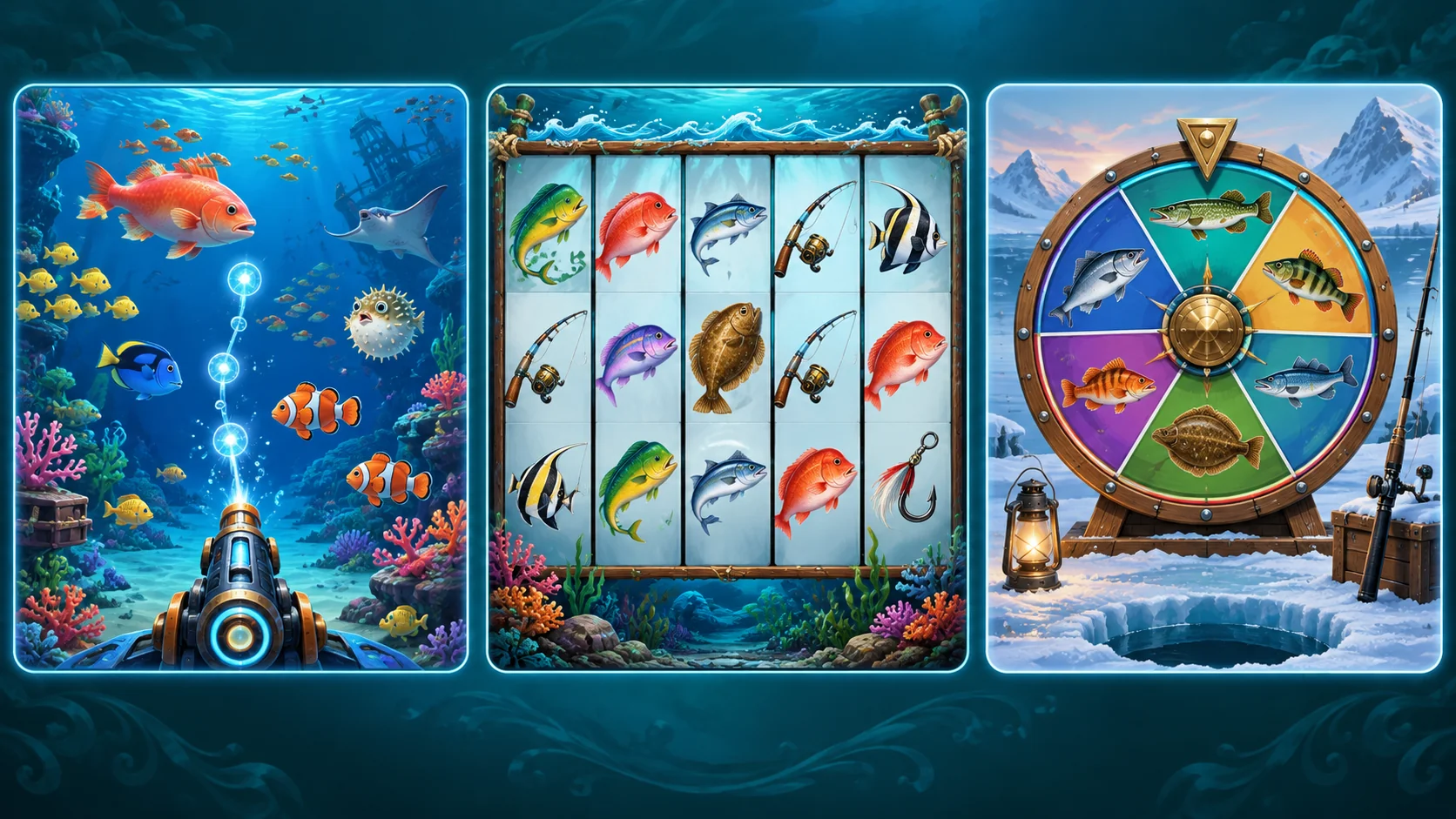
Fishing game types: separate the theme from the format
Fish, boats, rods and underwater scenes are thematic elements. Reels, target selection and a wheel are parts of a game’s presentation or interaction. The rules connect those elements to a qualifying event and an award.
Start with the full product title and provider. Next, look for the publisher’s category and the actual rule description. A search result calling everything a “fishing slot” may be using the word slot loosely. It is not a reliable classification by itself.
| Format | Typical visible structure | Rule information needed |
|---|---|---|
| Arcade fish shooting | A target field and virtual shooting controls. | What counts as a chargeable action, how features operate and how an award is recorded. |
| Fishing-themed slot | A reel grid with fish or fishing-related symbols. | Symbol evaluation, paylines or other matching rules, and feature conditions. |
| Fishing-themed game show | A presented main event and separate bonus sequence. | How the main result selects the next state and which conditions apply to the bonus. |
The three fishing game types compared here are broad categories, not universal specifications. A hybrid product may combine mechanisms, and only its own rules can settle an ambiguous classification.
Arcade example: Mega Fishing
JILI categorises Mega Fishing as “Fish and Arcade” and names features including a Special Octopus Wheel and a railgun. That identifies an arcade product with more than one feature presentation. The appearance of a wheel inside it does not make the entire product a roulette game.
The key distinction is between the ordinary target field and a particular feature state. A special mode can use its own counter or award display. Without knowing which state is active, a screenshot of a multiplier may be impossible to interpret accurately.
The Mega Fishing guide to inputs, features and award records explains those layers in detail. Its product-specific discussion should not be transferred automatically to another fishing title.
JDB separately identifies Cai Shen Fishing as a fish-shooting product. The existence of another arcade title supports the category, but does not make its ammunition counters, editions or feature rules interchangeable with JILI’s. Provider identity remains part of the answer.
Reel example: Fishin’ Frenzy Even Bigger Catch
Blueprint Gaming labels Fishin’ Frenzy Even Bigger Catch as a slot and publishes a line count for it. Its fish and fisherman imagery belongs to reel and feature rules, rather than a field of targets controlled by a virtual cannon.
A fishing-themed symbol may carry a value, act as part of a combination or participate in a collection feature. Its artwork cannot tell you which of those functions applies. The relevant questions concern the grid, the feature state and the qualifying rule.
For example, a fish on a reel is not evidence that someone selected or caught it through aiming. Likewise, a fisherman graphic does not establish that a live host is involved. Visual subject matter and result mechanism need separate descriptions.
Game-show example: Ice Fishing
Evolution places Ice Fishing in its live game-show category. Its public description identifies a virtual main wheel and fishing-themed bonus sequences. This is a useful warning against assuming that a live-category presentation makes every visible component a physical object generating the result.
The ordinary event and bonus are distinct states. Seeing a bonus unfold does not, by itself, establish that every observer has a qualifying account event. A displayed fish multiplier belongs to the rules of that particular sequence.
The guide to live formats and round records explains how a broadcast, interface message and account entry answer different questions. It is more relevant to that problem than advice about arcade aiming controls.
Three misleading shortcuts to avoid
“There is a fish, so the same rules apply”
Imagine a screenshot showing fish marked with numbers but no title or surrounding interface. Those numbers might be symbol values, target labels or bonus multipliers. Until the product and state are identified, none of those interpretations is confirmed. Cropping can remove exactly the information needed to choose between them.
“A wheel means roulette probabilities”
A wheel can be a graphical selector within an arcade feature or a separate game-show event. Its appearance does not establish equal segment probabilities, a physical mechanism or roulette settlement. Counting visible sections only becomes meaningful when the actual model and its assumptions are known.
“Moving a control proves that skill determines the reward”
An interface can accept user input without exposing how an award is determined. The presence of aiming, tapping or choosing is insufficient to measure how much influence that input has. Equally, the absence of visible controls does not reveal the full random process. Claims about skill or probability need product-specific evidence.
How to identify fishing game types without spending money
A useful identification record contains the full title, provider, edition, publisher category and relevant rule section. Add the visible game state if the question concerns a screenshot. An original product page is stronger evidence for classification than a reposted promotional caption.
Then describe only what the material supports: “The publisher lists this as a slot with reel features” is more precise than “all fishing games work like this”. If the product cannot be identified, keep the uncertainty explicit instead of borrowing specifications from the closest-looking title.
Comparing fishing game types does not establish safe returns, a guaranteed outcome or the legitimacy of a website using a product name. Gambling-related products can lead to financial loss; learning which format a title belongs to does not require participating in it.
