
The same deck can support games that compare totals, rank whole hands, form groups or reward getting rid of cards. This ABC8 card games guide explains those differences before looking at individual titles. A familiar ace, pair or sequence does not carry one universal value across games. The examples below teach rule interpretation and do not confirm which games are currently available through an ABC8-labelled service.
Begin with the objective, not the artwork
Pagat classifies card games by both mechanism and objective. That is useful because two games can use identical cards while asking players to achieve different things. Some categories overlap; a classification is a guide to the relevant questions, not a replacement for a rulebook.
| Game mechanism | What is evaluated | A question to resolve |
|---|---|---|
| Numerical comparison | A total calculated under that game’s card values. | Is an ace fixed or flexible, and is only part of the sum retained? |
| Ranked-hand comparison | A recognised arrangement ranked against another. | Which hand categories and tie-breakers apply? |
| Melding | Sets, runs and cards left unmatched. | Which groups qualify, and which remaining cards count? |
| Shedding | Progress towards emptying a hand. | What may legally be played and what ends the round? |
| Trick-taking | Cards contributed to successive tricks. | Which suit or rank wins a trick, and how are tricks scored? |
This comparison avoids a common shortcut: assuming that collecting high cards must always be good. A high card may contribute to a strong comparison, add unwanted unmatched points or serve a different purpose entirely. The objective tells you which interpretation to investigate.
One ace can participate in different arithmetic
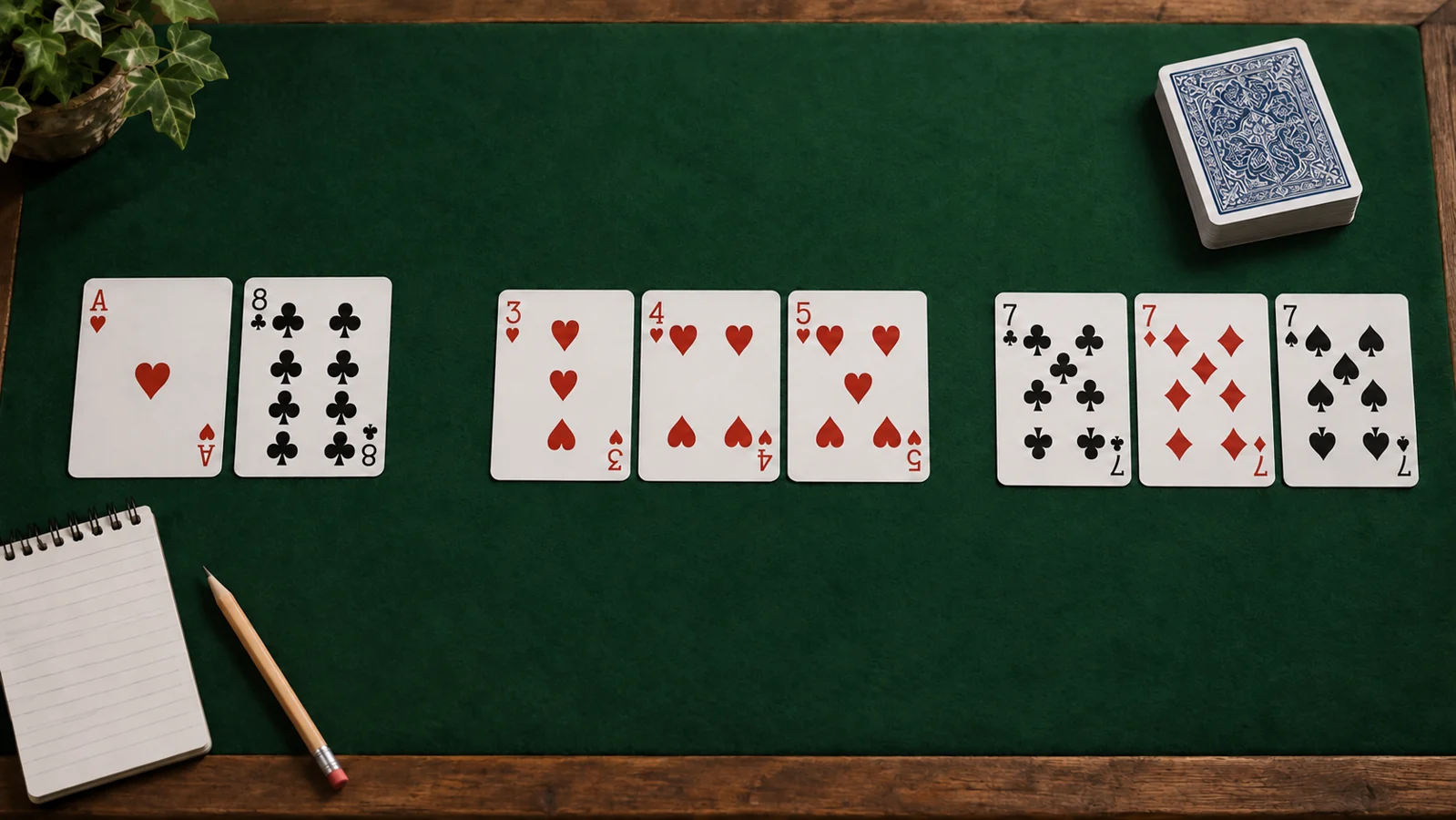
Bicycle’s blackjack explanation assigns an ace a value of 1 or 11, face cards 10 and number cards their printed values. Under that scoring convention, an ace and an eight can be represented as 9 or 19. This is an explanation of values, not advice about a subsequent decision.
In the traditional Tongits point system documented by Pagat, an ace is worth 1. If an ace and eight are unmatched cards being counted, their contribution is nine points. Whether a comparison is allowed and whether other cards form valid groups are separate questions.
SA Gaming’s published two-card Pok Deng rules also count an ace as 1, but retain the units digit of the total. To see a clearer difference, consider a king and an eight: blackjack counts 18, while that ordinary Pok Deng calculation counts 8 because the king contributes zero.
The cards did not change. The evaluation function did. Copying a card-value table from the wrong game can therefore produce perfectly consistent arithmetic and an incorrect answer.
A numerical total is not always the final ranking
Some rulebooks recognise special patterns in addition to ordinary totals. A pair, same-suit arrangement or named combination may affect ranking or settlement under a particular version. It is unsafe to conclude that all pairs are equivalent or that the larger ordinary total always settles the comparison.
Record three separate fields when relevant: the cards, their ordinary total and the recognised hand category. Then apply the rule that orders those categories. The Pok Deng guide to points and special hands gives a concrete example of why arithmetic alone can be insufficient.
A tie also needs a definition. Equal totals, equal categories and equal complete ranks are not necessarily the same condition. Some games apply further tie-breakers; others do not. The word “draw” on its own cannot settle which rule applies.
Melds depend on relationships between cards
In a typical rummy grouping, three cards of the same rank can form a set, while consecutive ranks in one suit can form a run. A sequence of numbers in mixed suits does not automatically qualify. An arrangement that looks tidy is not necessarily valid.
For example, 3♥–4♥–5♥ forms a same-suit sequence. Changing only the middle card to 4♣ removes that relationship. The printed values still add to twelve, but addition was not the test for a run.
Likewise, one physical card cannot be silently counted as a member of two separate groups in an arrangement that requires each card to be assigned once. Marking the membership of each group on paper can expose that error. The Tongits rules and deadwood examples develop the distinction between a valid group, a remainder and eligibility at the end of a round.
Deck assumptions change probability calculations
A probability statement needs to identify the deck and what is known about it. For a uniformly shuffled standard 52-card deck with four aces, the chance that the first card is an ace is 4/52 = 1/13. This is a mathematical model, not a measured rate for an online service.
If that first card is known to be an ace and is not replaced, three aces remain among 51 cards. The conditional chance that the next card is an ace is then 3/51 = 1/17. If instead a known non-ace was removed, the corresponding count would be 4/51.
Those examples cannot be transferred unchanged to a multi-deck shoe, a deck with jokers or a game that reshuffles between events. They also assume the stated information is actually known. A partly obscured screenshot is not a complete inventory of the remaining deck.
A game family is different from its digital presentation
ABC8 card games can be presented through a physical deck, an animated interface or a live broadcast. The presentation does not by itself establish the exact scoring rules, the number of decks or how interruptions are handled.
For identifying a specific table-game guide, use the ABC8 Casino directory. Keep the full variant name with any rule you record. A label such as “speed”, “classic” or “special” may require further explanation rather than being merely decorative.
The comparisons in this article can be explored with an ordinary deck and paper without paying to participate. They do not identify profitable hands or a system for recovering losses. Where money is involved, knowing the scoring system does not eliminate uncertainty or financial risk.
