
Fortune Gems is a JILI slot title whose public description lists five paylines, a multiplier feature and whole-board bonuses. Its right-side multiplier display represents a different part of the calculation from the symbols on a line. Understanding that separation is more useful than treating every bright symbol or large number as a cash award.
Identify which Fortune Gems is being described
The original product is called Fortune Gems, with a plural “Gems”. JILI also lists Fortune Gems 2 separately, describing a Lucky Wheel feature in that edition. A guide that quietly combines the original and sequel can give a convincing but incorrect account of either game.
Match the full title and publisher with the information panel of the particular product. A similar thumbnail is weak evidence: sequels can preserve the visual theme while changing the feature sequence. Public catalogue descriptions establish product identity and headline features; the in-game rules are needed for the exact award calculation.
Five paylines do not mean five independent chances
A payline is a path used to evaluate symbols. Several paths can pass through the same position on a grid, so their results need not be independent.
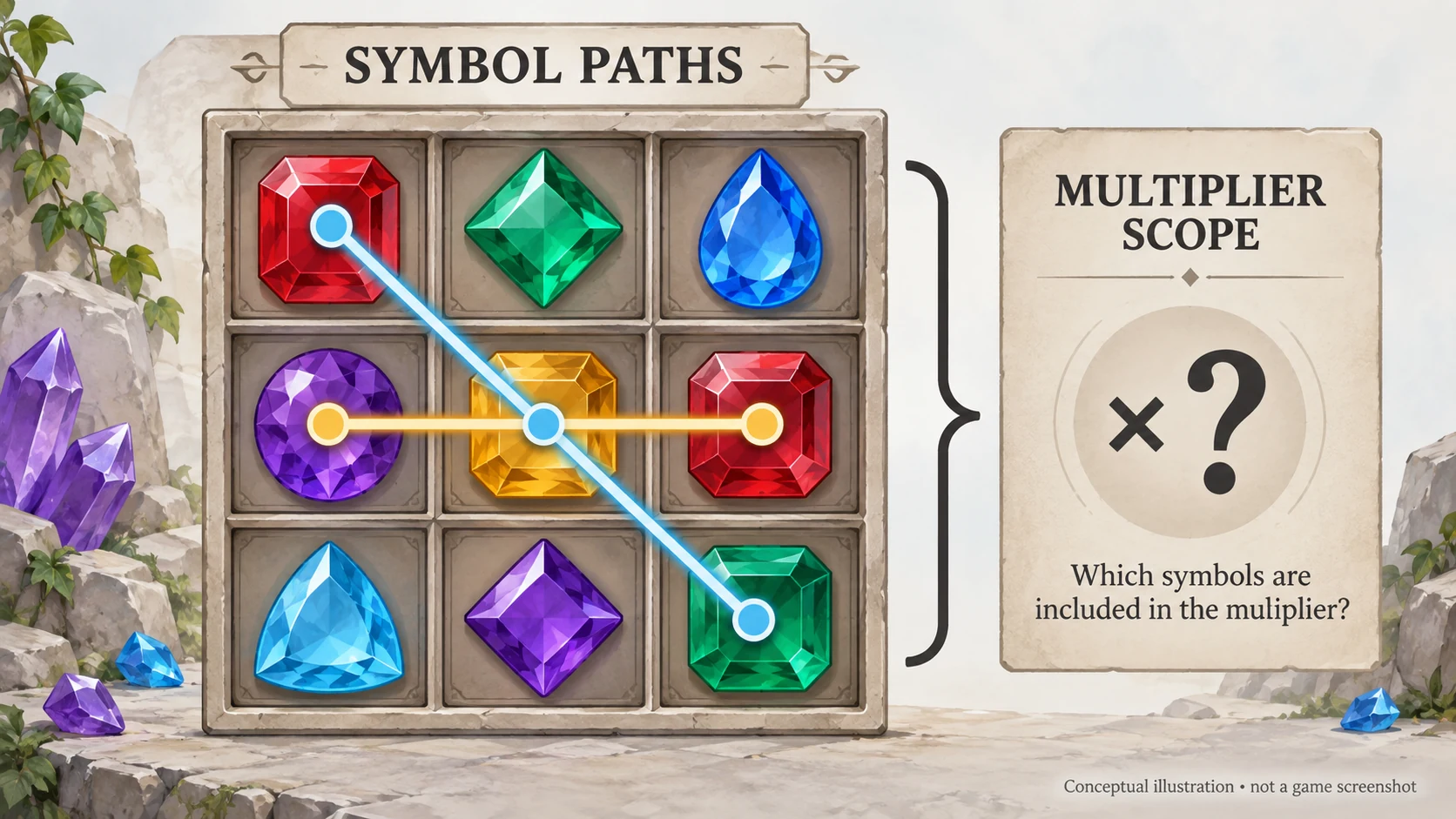
Imagine a simplified grid with a horizontal path and a diagonal path that both cross the centre. Changing the centre symbol could affect both paths at once. Counting two paths tells us how many patterns are evaluated, but it does not tell us the probability that either path meets its award condition.
The same distinction applies to the five-line label. It is not a five-in-something probability, nor evidence that five-line games have a higher return than games with fewer lines. To calculate the chance of at least one qualifying path, we would need symbol probabilities and the overlap between qualifying events. Those details cannot be recovered just by counting visible lines.
Even the number of symbol types is insufficient. A digital symbol can occur more or less frequently than another; equal space in an illustrated paytable does not establish equal likelihood.
Keep the line award and multiplier scope separate
A multiplier needs a base amount. It may apply to an eligible line award, a combined subtotal or another amount defined by a feature. Its location on a screen does not resolve that rule.
For a fictional arithmetic example, suppose two eligible line awards are 4 and 6 credits and a rule applies ×3 to their combined subtotal. The calculation would be (4 + 6) × 3 = 30 credits. If only the 4-credit line were eligible, it would instead be 4 × 3 + 6 = 18 credits. These are contrasting examples, not asserted Fortune Gems payout rules.
That difference shows why a cropped image containing only “×3” cannot establish an underpayment. The underlying awards, eligibility and recorded calculation are needed. Also distinguish credits from currency: 30 credits is not automatically ₱30.
A whole-board feature is a separate rule question
JILI’s original-game description refers to a whole-board bonus associated with its Garuda imagery. That description does not, by itself, explain how any special award interacts with ordinary line awards.
There are several possible accounting relationships in game rules: a special award might replace another award, be added to it, or have a separate multiplier condition. These possibilities should be checked, not assumed. Counting every animation as a separate payable event can double-count an amount already included in a displayed total.
A useful historical record therefore contains the full grid, applicable feature state and final round total. If a help page specifies an exception for a full-board result, retain that text alongside the record rather than applying a general line rule to every situation.
What a multiplier cannot tell you about risk
A larger displayed multiplier describes a scale, not how often the necessary outcome occurs. A maximum award is not an expected award. Neither figure tells you how many losing outcomes could occur before another positive result.
Random outcome generation also does not mean every visible symbol or award is equally likely. The UK Gambling Commission’s technical standard distinguishes random input from the mapping to a game’s theoretical outcome probabilities. That is a general technical reference, not certification of a particular ABC8 implementation.
The explanation of slot RTP and volatility covers why long-run averages cannot predict a personal session. If a description uses the word “jackpot”, the guide to jackpot types and eligibility helps distinguish a separate prize mechanism from an ordinary multiplied line award.
No timing pattern or sequence of earlier symbols supplies the missing probability model. Where exact rules are unavailable, the appropriate conclusion is that the calculation remains unverified—not that another round will resolve it.
