
Money Coming is a JILI slot product built around numerical symbols and wheel features. A number on its grid is not self-explanatory: it may need a unit, a feature condition or another value before it can be interpreted. Reading the complete rule and final record matters more than adding every visible number.
What the public description establishes—and leaves open
JILI’s original Money Coming listing names Special Wheel and Lucky Wheel features. Its catalogue field says “1 line”, while the description says prizes do not require connecting lines. These are different kinds of description. The short catalogue label should not be treated as a complete explanation of symbol evaluation.
Rather than inventing a conventional line-matching rule, identify how the exact version defines the numerical grid, qualifying symbols and final award. A product summary can introduce a mechanism without specifying every condition needed to reproduce its calculation.
Money Coming 2 has a separate JILI listing and describes a WIN UP symbol. That sequel’s feature should not be imported into an explanation of the original simply because both products use numbers and similar branding. Record the complete edition name when comparing a help screen with an older screenshot.
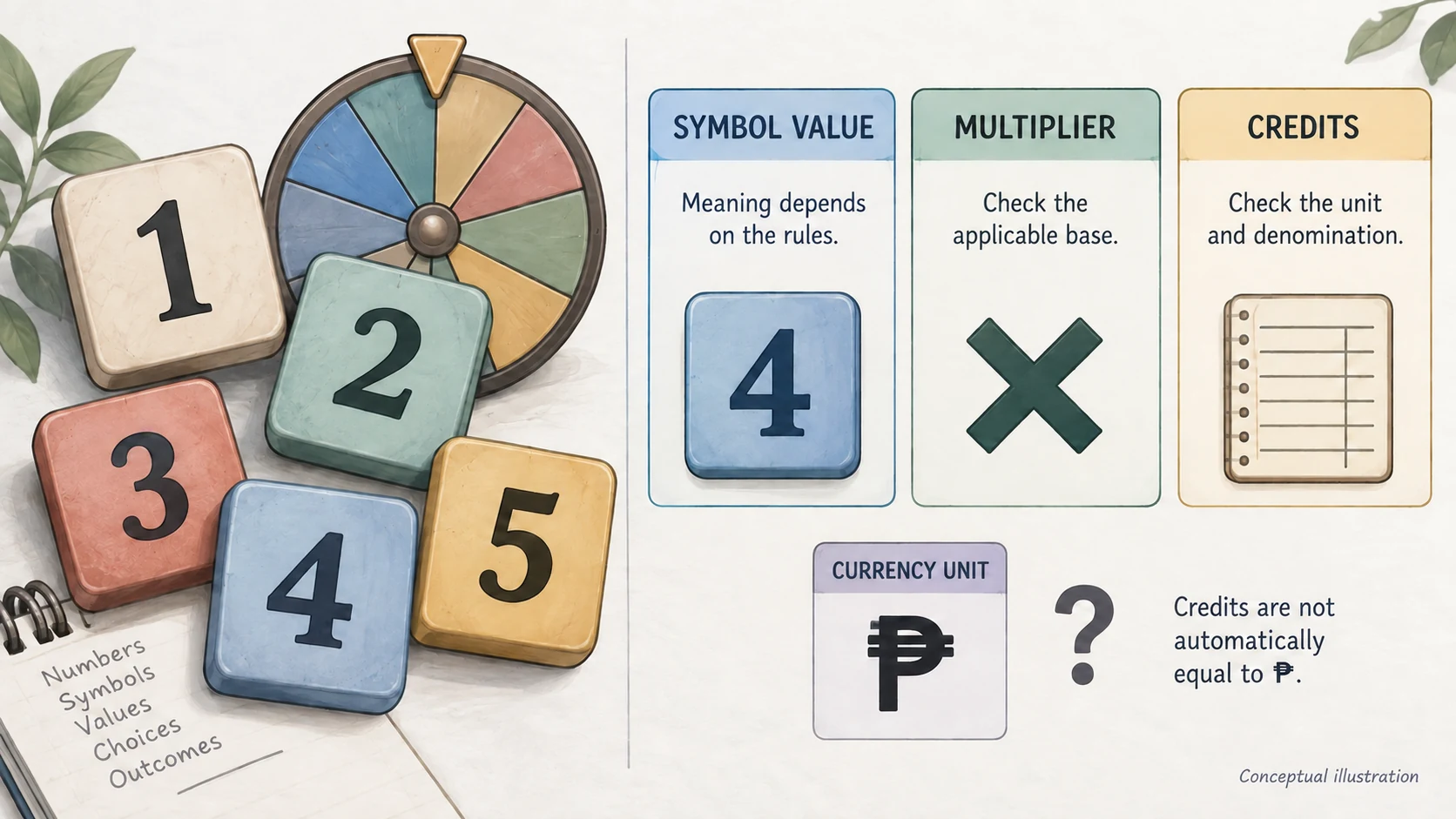
Every displayed number needs a unit
Four different meanings can look similar on a small screen:
| Example label | Meaning to establish | Common misreading |
|---|---|---|
| Number on a symbol | A value whose role is defined by the game rules. | Assuming it is already an amount of cash. |
| × value | A multiplier applied to a specified base. | Adding it to other numbers as if it were an award. |
| Credit total | An accounting quantity in the game’s units. | Treating one credit as one peso without checking. |
| Account credit | An entry in the account’s stated currency or balance type. | Assuming it equals the net gain for the round. |
In a fictional example, a recorded award of 24 credits with a stated value of ₱0.50 per credit equals ₱12. If the same record also contains a ₱10 debit, those two entries produce a ₱2 net increase. The arithmetic does not establish that Money Coming uses that denomination; it demonstrates why omitting units changes the interpretation.
Do not use an assumed exchange rate to resolve a discrepancy. Retain the denomination or conversion shown in the relevant record and check whether it changed between screenshots.
A feature animation is not necessarily another transaction
A wheel can be a stage within one round. The account may show a single final credit even though the presentation showed several intermediate events. Conversely, a record can identify a separate adjustment after the first total.
To understand which situation occurred, place the available information in order: initial result, named feature, displayed intermediate value, final total and account entry. Use the round reference to keep the stages together. Do not add an intermediate total to a final total unless the rules make clear that they are separate awards.
For example, if a presentation first shows 8 units and later shows “total 20”, the sum is not automatically 28. The later figure might include the earlier 8. The word “total”, the feature rules and the settlement breakdown are needed to decide. A screenshot taken between stages cannot settle that question on its own.
What cannot be inferred from a large number
A large possible award supplies no information about its frequency. The wheel’s visual size is also not enough to establish the probability of a feature result. A digital presentation may not use the equal-area model people associate with a simple physical spinner.
Similarly, a run of small numbers is not evidence that a larger one is due. A claim about future results needs information about the outcome process; an edited highlight reel provides only selected examples. It usually omits the number of rounds and losses surrounding the featured result.
For the distinction between average return and the spread of outcomes, see slot RTP and volatility. Neither concept turns a product name or a memorable wheel animation into a dependable forecast.
Describe a disagreement with a complete calculation
An effective enquiry identifies the edition, round reference, units, feature state and disputed amount. Ask which values were included in the final total and which rule governed the calculation. Avoid asserting a specific missing payment from a cropped multiplier or number tile alone.
If the disagreement concerns a payment entering the account rather than the game calculation, use the separate payment incident evidence checklist. Preserve originals privately, redact sensitive account information in shared copies and never disclose verification codes. Additional spending cannot supply a missing historical record.
