
Color Game probability depends on the event being counted and the rules behind the dice. One named colour appearing at least once, that colour appearing on all three dice, and any colour forming a triple are different events. This guide calculates those differences using an explicit fair-dice model, then explains why the numbers cannot automatically be assigned to a digital game with the same name.
Define the model before quoting a percentage
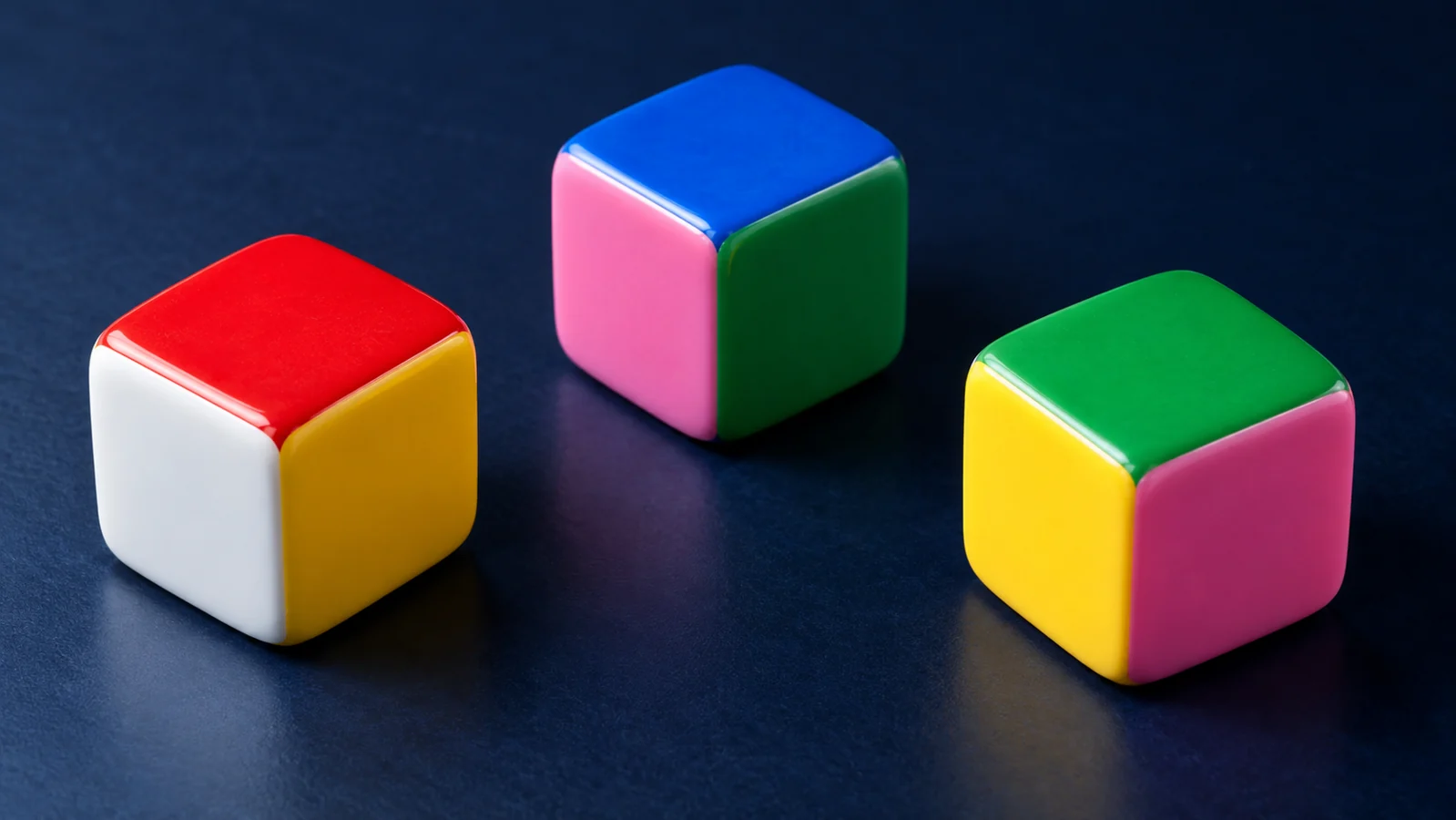
For the calculations below, assume three dice, six distinct colours on each die, one face per colour, equally likely faces and independent dice. Each roll is also assumed independent of previous rolls. These are mathematical assumptions for an educational example. They are not findings about the construction, software or certification of an ABC8-linked product.
Label the dice A, B and C. There are 6 × 6 × 6 = 216 equally likely ordered outcomes. Red–blue–green and blue–red–green occupy different places in that sample space because the colours are assigned to different dice. Ignoring the order when counting, while still dividing by 216, would produce inconsistent results.
Color Game probability for one named colour
Choose red as the colour being counted; any other colour gives the same figures under these assumptions. Each die has one red face and five non-red faces. “Exactly one red” includes the possibilities in which red is on A, B or C.
| Red faces in one roll | Counting calculation | Outcomes | Probability |
|---|---|---|---|
| None | 5 × 5 × 5 | 125 | 125/216 ≈ 57.87% |
| Exactly one | 3 × 1 × 5 × 5 | 75 | 75/216 ≈ 34.72% |
| Exactly two | 3 × 1 × 1 × 5 | 15 | 15/216 ≈ 6.94% |
| Exactly three | 1 × 1 × 1 | 1 | 1/216 ≈ 0.46% |
The outcome counts add to 216, which checks that the four categories cover every possibility without overlap. Their displayed percentages may not add to exactly 100 because of rounding.
For at least one red, add the last three counts: 75 + 15 + 1 = 91. The result is 91/216, approximately 42.13%. The complementary calculation is 1 − 125/216. It answers a different question from “exactly one red”, whose probability is about 34.72%.
A named triple is not the same as any triple
Red–red–red is one ordered outcome. An all-blue roll is another, and each of the six colours has its own all-matching outcome. Consequently, a specified-colour triple has probability 1/216, while any same-colour triple has probability 6/216, or 1/36, approximately 2.78%.
This distinction matters when interpreting a label such as “triple”. Does it refer to one named colour, any colour, or a special condition that also requires another event? The label alone does not answer that question. A rule tied to a particular colour cannot be evaluated using the any-colour figure.
It is also wrong to add “at least one red” and “at least one blue” as though they were mutually exclusive. Red–blue–green belongs to both groups. Adding their probabilities without accounting for that overlap counts some rolls twice. Write the event in a complete sentence before attempting a calculation.
What a run of missing colours actually tells you
Under the independent-roll model, red being absent from previous rolls does not change its next-roll probability. For instance, the chance of no red in five consecutive rolls is (125/216)5, about 6.49%. Such a sequence is possible within the model; it does not create a requirement for the sixth roll to contain red.
Likewise, 91/216 is a probability, not a promise that every block of 216 observed rolls contains red exactly 91 times. An observed count can differ. A screenshot of a short streak therefore does not establish a predictable cycle, and selecting only unusual screenshots creates an additional sampling problem.
To describe a sample clearly, record every consecutive round in the chosen interval, its identifier, the three displayed results and the rule version. State where the sample starts and ends. Do not combine omitted rounds, bonus events and ordinary rolls into one unexplained total.
Digital Color Game versions can use different conditions
JILI’s public catalogue includes a Color Game entry with a special condition associated with three green results, and a separate Color Game Extreme description with a Super Dice feature. Those product descriptions demonstrate why the same family name should not be treated as one universal mathematical specification.
A dice animation does not reveal the distribution used to select its result. Additional multipliers or a special die may change the relevant event or settlement model. Without the exact rules, it would be misleading to present the fair-dice table above as that product’s verified probabilities.
The UK Gambling Commission’s technical standard for random outcomes distinguishes expected distributions, unpredictability and implementation according to the rules. That is a useful technical distinction, not evidence that a particular Philippine website falls under that standard or has passed a test. A general statement about RNG cannot certify a specific game.
Probability alone does not establish a return percentage
The chance of an event and the amount returned when it occurs are separate inputs. Calculating a theoretical return requires the complete outcome probabilities and the corresponding settlement amounts, including how the original amount is treated. A headline multiplier provides only part of that information.
The guide to RTP, volatility and outcome distributions explains why a long-run average cannot promise a result for one session. For colour dice, the first task is even more basic: establish which event the percentage describes and whether the model’s assumptions apply.
These calculations can be explored with paper or ordinary dice without risking money. They do not identify a favourable colour, a recovery system or a profitable time to participate. If money is involved, a clear rulebook and correct arithmetic still do not remove financial risk.
