
Pok Deng is a Thai card game in which hands are compared with a Banker, but a shared name does not guarantee a shared rulebook. Traditional descriptions and modern live versions can differ in card drawing, special-hand rankings and settlement. The most useful starting point is to separate three things: the cards’ numerical total, any recognised pattern and the rule that decides the comparison.
Traditional Pok Deng and a two-card live version
Pagat describes a traditional form in which two-card totals of eight or nine are called Pok; a third card can be part of other hands under the applicable drawing rules. That description should not be applied automatically to a live table with a fixed two-card layout.
SA Gaming’s published Pok Deng format instead shows five Player positions and a Banker. Each position receives two cards and is compared with the Banker separately. Its published rules specify an eight-deck shoe without jokers and include special combinations. This is a documented example of a particular provider’s format, not confirmation that a table bearing the same name on another website uses that version.
Look for the provider, full game title and help panel together. A table number or a studio label is not a complete rules identifier. The live casino format and records guide explains the broader difference between a game family, a table and its provider.
Calculate the ordinary total first
In SA’s published two-card rules, an ace is 1, cards 2 through 9 keep their numerical values, and 10, J, Q and K contribute zero. Only the units digit of the sum is retained. The following calculations are arithmetic examples, not complete hand rankings.
| Two cards | Addition | Ordinary total |
|---|---|---|
| 6♣ and 7♦ | 6 + 7 = 13 | 3 |
| 9♠ and 9♥ | 9 + 9 = 18 | 8 |
| A♦ and 6♠ | 1 + 6 = 7 | 7 |
| K♥ and 4♣ | 0 + 4 = 4 | 4 |
The second row also contains a pair. That additional observation does not change 18’s units digit. It gives the rulebook another property to evaluate. Keeping the two observations separate prevents a common error: rewriting the arithmetic to explain a pattern-based result.
Why the higher ordinary total may not settle the hand
SA’s ranking table places specified special combinations between ordinary seven and eight. A same-suit ace and king is one example; certain pairs are also special, but not every pair has the same ranking treatment. Pattern-related settlement provisions include exceptions.
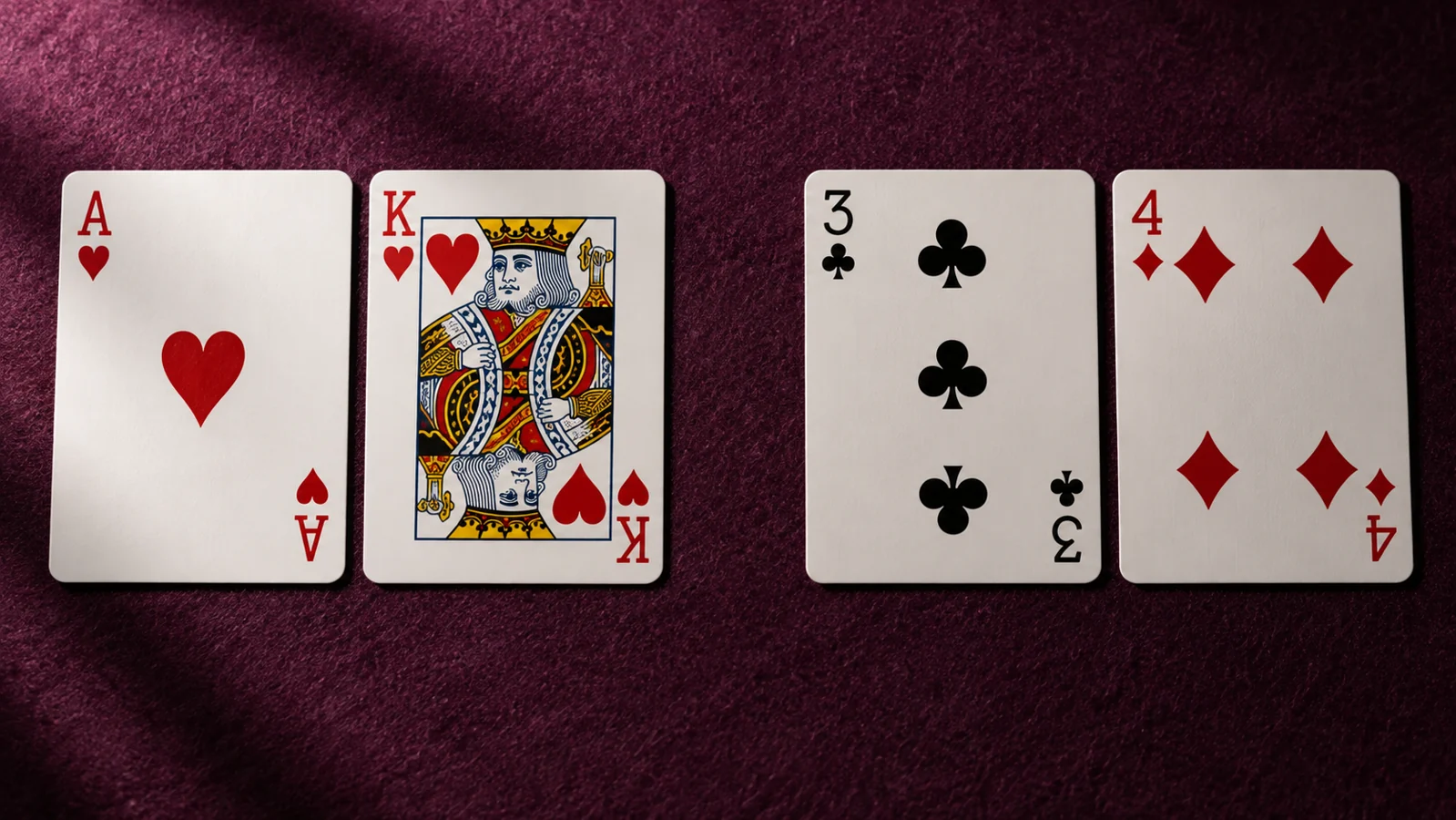
Consider A♥ and K♥ against 3♣ and 4♦. Their ordinary totals are 1 and 7. Under the documented SA special-ranking rule, the same-suit ace–king outranks ordinary seven. An explanation that says “seven always beats one” would miss the decisive property of the first hand. In another version, the appropriate result must come from that version’s rules.
This is why a result should be recorded in two columns: ordinary total and recognised hand category. A displayed intermediate rank is an ordering label, not necessarily the result of adding fractional card values. Do not invent a numerical formula to replace a category table.
Nor does winning a comparison alone determine the amount shown in a balance record. The settlement schedule, applicable exception and accounting treatment still need to be known. A large animation or a highlighted pair is insufficient evidence of a particular credit amount.
Similar scoring does not make it baccarat
Both games can use a units-digit total, which makes screenshots look familiar. That resemblance does not transfer drawing rules, side-option definitions or special-hand rankings. A borrowed baccarat explanation could calculate an ordinary total correctly and still explain the overall result incorrectly.
For the distinction between card arithmetic, comparisons and separate result categories, see the baccarat guide to rules and result terminology. Use it to understand the questions being asked, then return to the Pok Deng rules for the actual answers. It is not a substitute rulebook.
Five Player positions are not five independent experiments
In the described live format, the same Banker hand appears in each comparison. A strong Banker hand can therefore affect several displayed results at once. Five positions losing in one round is a different observation from one position losing across five separate rounds.
For example, a screenshot might show Player 1 through Player 5 all below the Banker. Counting that as five consecutive rounds would distort both the time sequence and the sample size. A record should identify the round once and attach the five position results to it.
Cards also come from a finite shoe in this documented version. Exact probabilities require the deck model, relevant remaining-card information, ranking rules and the precise event being counted. Neither a few screenshots nor a row of result icons supplies all of that information. This guide does not assign an unverified win rate or claim a pattern predicts the next hand.
Build a record that can explain an unclear result
Preserve the provider and table identifiers, round ID, timestamp with time zone, both compared hands, displayed totals and any special-hand label. Include the help-panel rule that appears relevant. If the issue concerns an amount, keep the associated transaction entry separately from the card screenshot.
A useful description is: “The ordinary totals were X and Y; this hand category was displayed; this rule appears to apply; the recorded result was Z.” It is more informative than “the cards looked higher”. If a video frame does not show all the cards, mark the missing information instead of reconstructing it from memory.
Share only the records needed for review and hide account identifiers that are unrelated to the question. Do not provide a password or one-time code to someone offering to investigate a result. If unresolved financial losses or repeated result checking are causing pressure, stop rather than treating another round as a way to settle the issue. Understanding the classification system does not remove the possibility of losing money.
