
Tongits rules combine two questions: which cards form valid groups, and who is eligible to have their remaining points compared when the round ends? A low total alone does not explain every result. This guide separates melds, unmatched cards and ending conditions, with examples you can follow using an ordinary deck and paper. It describes the traditional card game and common terminology; it does not establish the rules or availability of an ABC8-labelled app.
What kind of card game is Tongits?
Tongits is a three-player rummy game associated with the Philippines. Its organising idea is to group cards into sets or same-suit sequences while reducing the value of cards left unmatched. The standard traditional description uses 52 cards without jokers. This makes it different from games that judge a single five-card poker hand: the arrangement of several groups, the remaining cards and the state of the round all matter.
The developer descriptions for Tongits Card Game and Tongits – Offline Card Games also describe a three-player game involving sets, runs and unmatched-card totals. Their wording for endings is not identical. Treat a familiar game name as a starting point, rather than proof that every button and exception will work the same way.
Check a meld before subtracting its points
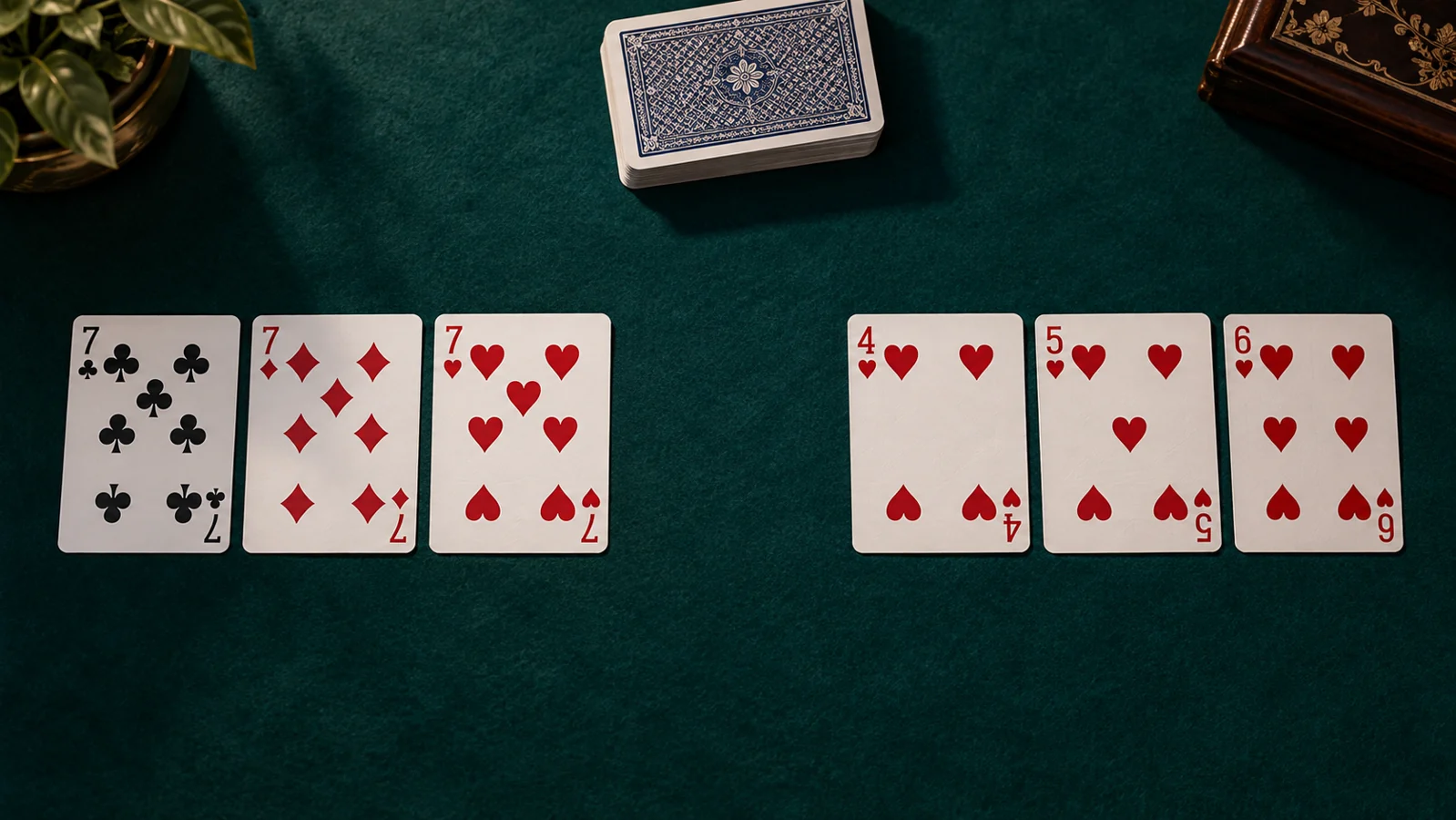
A set groups at least three cards of the same rank. A run groups at least three consecutive ranks in the same suit. Two matching cards are therefore an incomplete set, and a sequence of numbers across different suits is not a run. These examples illustrate group recognition; they are not recommendations about which card to keep or discard.
| Cards shown | Assessment | Reason |
|---|---|---|
| 7♣, 7♦, 7♥ | Valid set | Three cards share the same rank. |
| 4♥, 5♥, 6♥ | Valid run | The ranks are consecutive and the suit is unchanged. |
| 4♥, 5♣, 6♥ | Not a run | The middle card belongs to a different suit. |
| 8♠, 8♦ | Incomplete set | There are only two cards. |
| 3♣, 5♣, 6♣ | Not a run | A gap remains between 3 and 5. |
Count each physical card once. For example, the same 7♥ cannot simultaneously complete three sevens and a 5♥–6♥–7♥ run in one scored arrangement. Writing each group on a separate line makes an accidental overlap visible. A screenshot with cards close together can hide this problem, especially when a card appears to sit between two groups.
Tongits rules for points: a worked hand audit
In the traditional point system, an ace counts as 1, number cards count at face value, and J, Q and K count as 10 each. The value being compared is the unmatched remainder, not the sum of every printed number on the table.
Consider a fictional remaining hand arranged as 7♣–7♦–7♥, 4♥–5♥–6♥, A♠ and K♣. Assume both three-card groups qualify under the rules being used. The unmatched remainder is A♠ plus K♣: 1 + 10 = 11 points. The six grouped cards do not add to that remainder.
Now change only 5♥ to 5♣. The three sevens remain a set, but 4♥–5♣–6♥ no longer forms a same-suit run. On this simplified arrangement, those cards return to the unmatched count: 4 + 5 + 6 + 1 + 10 = 26 points. The difference comes from an invalid group, not a change in the value of the king.
This calculation establishes a remainder only. It does not declare the hand a winner. Another hand may have a lower eligible total, or the applicable ending rule may prevent a comparison. Keeping the arithmetic separate from eligibility makes a disputed result easier to describe precisely.
Three endings that should not be treated as one
Pagat’s traditional account distinguishes using all cards in valid combinations, exhausting the stock, and calling Draw. It also describes opening requirements, restrictions after laying cards onto melds, and different tie handling. An unopened player can be treated as burned, or sunog. These conditions explain why “my points were lower” may be an incomplete description.
A useful reading order is: identify what ended the round, establish who was eligible, calculate the eligible remainders, then apply any tie rule. Reversing that order can produce an apparently convincing score comparison that the rules never permitted.
The word draw needs particular care. Taking a card from a pile, declaring a comparison and describing an equal result are different ideas. Some app descriptions use Fight for a challenge. Record the exact button or message rather than translating all of these actions into “draw”.
Why two Tongits apps can disagree
Published app descriptions illustrate the naming problem: one product marketed as Tongits Offline: Tonk Card Game describes five-card hands, whereas traditional Tongits is commonly described with larger hands. This is a substantive format difference. A shared keyword in an app title cannot resolve it.
Before interpreting a result, locate the rules for that exact product and check the deck, starting hand size, treatment of aces, opening condition, challenge timing, tie order and disconnection policy. If a help page does not answer a point, leave it unresolved rather than importing a rule from another app.
For a record review, retain the round identifier, the ending message, the complete visible hand, exposed groups and the relevant rule text. Crop unrelated personal details before sharing a screenshot. A single card total without the ending message cannot establish whether the result was calculated incorrectly.
Understanding the game without risking money
The examples above require no payment or gambling account. Physical cards and a written score sheet are enough to practise identifying valid groups and checking addition. An app’s “free” label should still be read alongside its purchase information and permissions; it does not establish that every feature is cost-free or that an unrelated download is trustworthy.
If you are comparing Tongits with dealer-table games, the card-game scoring and game families guide provides the broader context. Keep the distinction clear: a rummy hand with melds is not evaluated using baccarat totals or poker rankings. Where money is involved, rule knowledge does not guarantee a favourable result or eliminate financial risk.
